Why Your AC Bill Spikes in Iowa Summers (And What’s Really Driving It)
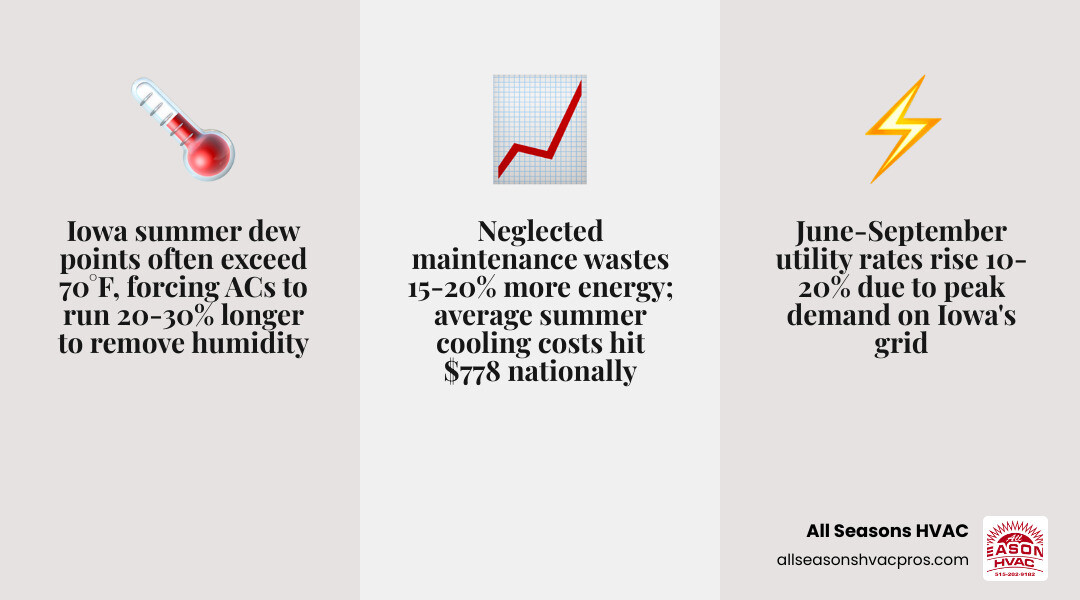
Why your ac bill spikes in iowa summers comes down to a combination of factors working against you at the same time: rising outdoor temperatures force your AC to run longer, Iowa’s high summer humidity makes your system work harder than the thermostat number suggests, and utility rates quietly shift upward between June and September.
Here are the main reasons your Iowa cooling bill climbs every summer:
- Iowa heat and humidity push your AC to run more hours per day than in drier climates
- June–September rate increases mean you pay more per kilowatt-hour during peak cooling months
- Peak demand charges add costs on the hottest afternoons when the grid is most stressed
- Neglected AC maintenance causes systems to consume 15–20% more energy than a well-tuned unit
- An aging AC system (10+ years old) loses efficiency every season, running longer to do less
- Heat gain from poor insulation, air leaks, and windows makes your AC fight a losing battle
- Summer lifestyle changes — kids home from school, more appliances running — quietly add to your load
This is not just an Iowa problem, but Iowa homeowners face a specific mix of climate and grid factors that make summer bills especially unpredictable. Nationally, the average electricity cost for cooling a home from June through September is projected to reach $778 this summer — an 8.5% jump from last year, according to the National Energy Assistance Directors Association. Midwestern households like those in Iowa are expected to see roughly $30 more per household compared to last summer.
The good news? Most of the causes are fixable — and many cost nothing to address. This guide walks you through each one.
Understanding Why Your AC Bill Spikes in Iowa Summers
In Central Iowa, we don’t just deal with heat; we deal with “corn sweat.” The massive amount of moisture released by our agricultural landscape drives the dew point to uncomfortable levels. This humidity is a primary reason why your ac bill spikes in iowa summers. Your air conditioner has two jobs: lowering the temperature and removing moisture. When the humidity is high, the evaporator coil has to work double-time to wring water out of the air before it can even begin to lower the “sensible” heat you feel on your skin. If you feel like your home is sticky even with the air running, you might want to investigate AC Making Your Home Humid to see if your system is sized correctly or functioning properly.
Furthermore, Iowa utilities like Alliant Energy and MidAmerican Energy often adjust their structures during the “on-peak” summer months. From June to September, the cost to produce and distribute electricity rises because everyone is running their cooling systems simultaneously. If your home or farm operation is subject to peak demand charges, those few hours between noon and 8 p.m. on a 95-degree day can account for a massive portion of your monthly bill.
Interestingly, Iowa is somewhat shielded from the extreme natural gas price volatility seen in other states. Thanks to our state’s commitment to wind energy—which provides over 40% of the electricity in Iowa—our rate increases have remained relatively modest compared to places like Maine or California. However, if your unit is struggling to keep up despite these stable rates, you should check Why Your AC Is Not Cooling Properly to rule out mechanical failure.
Mechanical Inefficiencies and Maintenance Gaps
One of the most common—and preventable—reasons why your ac bill spikes in iowa summers is a neglected system. In the Des Moines area, we deal with “cottonwood season” right as the heat kicks in. Those fluffy white seeds act like a blanket for your outdoor condenser unit, choking off airflow and forcing the compressor to work much harder to reject heat. A neglected AC system can easily use 15–20% more energy than a well-maintained one.
Maintenance gaps often manifest as:
- Dirty Air Filters: A clogged filter is the #1 cause of Solving Poor AC Airflow Problems. When air can’t move, the system runs longer to reach the target temperature.
- Short Cycling: If your unit turns on and off every few minutes, it’s consuming massive amounts of “startup” electricity without ever dehumidifying the home. Explore AC Short Cycling Causes to understand why this happens.
- Biological Growth: If your system smells “musty” when it kicks on, it’s likely working against restricted airflow caused by buildup on the coils. Check out Fixing AC Odors Maintenance Tips for solutions.
Why your ac bill spikes in iowa summers due to aging equipment
If your AC system is over 10 years old, it was likely manufactured under older SEER (Seasonal Energy Efficiency Ratio) standards. As of 2023, the industry moved to SEER2, which requires much higher efficiency levels. An older unit doesn’t just lack the technology of a modern system; it also suffers from mechanical wear that degrades its efficiency every year. If you find yourself calling for repairs every July, it might be time to look for Signs You Need AC Replacement. Also, listen closely to your unit; if it’s struggling, it will often tell you. Is Your AC Making Strange Noises? If so, it’s likely drawing more power than it should.
Why your ac bill spikes in iowa summers from hidden system leaks
Your AC is a closed-loop system. It should never “run out” of refrigerant. If the levels are low, you have a leak. Low refrigerant makes the system run constantly because it can’t absorb enough heat to satisfy the thermostat. This leads to massive bill spikes and can eventually cause the evaporator coil to freeze solid. If you notice ice on your indoor unit or see water pooling on the floor, you need to know How to Fix a Frozen AC Evaporator Coil and check for AC Refrigerant Leak Signs. Ignoring a leak doesn’t just raise your bill; it can lead to a Why Is My AC Leaking Water? situation that damages your drywall or flooring.
Environmental Factors and Household Habits
Sometimes, the reason why your ac bill spikes in iowa summers isn’t the machine—it’s the humans inside the house. In June, when school lets out, household energy patterns shift dramatically. Kids are home, which means doors are opening and closing more often, electronics are running all day, and more lights are left on.
Additionally, we often forget that our appliances generate heat. Running a dishwasher or oven at 2 p.m. on a Tuesday adds to the “heat load” your AC has to fight. This can even lead to Common AC Electrical Problems if the system is pushed to its absolute limit during peak hours.
| Appliance | Peak Hour Cost (Est.) | Off-Peak Hour Cost (Est.) | Savings Potential |
|---|---|---|---|
| Clothes Dryer | High | Low | Shift to after 8 PM |
| Dishwasher | High | Low | Use delay start |
| Electric Oven | High | Medium | Grill outside instead |
Why your ac bill spikes in iowa summers because of poor insulation
Your home is like a cooler. If the lid is cracked or the insulation is thin, the ice (your cold air) melts quickly. In Central Iowa, many older homes in areas like Des Moines or Indianola have attic insulation that has settled over time. On a 90-degree day, your attic can reach 140 degrees. Without proper insulation, that heat transfers directly through your ceiling.
Air leaks around windows and doors also allow our famous Iowa humidity to seep inside. Simple fixes like weatherstripping and using blackout curtains on south-facing windows can significantly reduce the workload on your AC. If your home gets too hot because of these leaks, the system might eventually quit altogether. If that happens, knowing What to Do When AC Won’t Turn On can save you a lot of stress.
Actionable Strategies to Lower Your Iowa Cooling Costs
We want you to stay comfortable without dreading the mailbox. Here are the most effective ways to lower your Iowa cooling costs:
- The 78-Degree Rule: The Department of Energy recommends setting your thermostat to 78°F when you are home and awake. While this sounds warm, using it in combination with fans can keep you comfortable while saving up to 10% on cooling costs.
- Ceiling Fan Direction: Ensure your fans are spinning counter-clockwise. This pushes air straight down, creating a “wind-chill” effect on your skin. Remember: fans cool people, not rooms, so turn them off when you leave!
- Smart Thermostat Automation: A smart thermostat can take the guesswork out of “Smart Hours” programs offered by utilities like Alliant Energy. It can pre-cool your home in the morning and let the temperature rise slightly during the most expensive peak hours.
- Utility Rebates: Both MidAmerican and Alliant Energy offer rebates for high-efficiency equipment and smart thermostats. Check their websites before you upgrade!
- No-Cost Habits:
- Keep interior doors open to allow for balanced airflow.
- Close shades and blinds during the day to block solar heat gain.
- Unplug “vampire” electronics that generate heat even when not in use.
- Avoid using the dryer or oven until after 8 p.m.
Frequently Asked Questions about Iowa Summer Energy Bills
What is the ideal thermostat setting for Iowa summers?
The ideal setting for a balance of comfort and savings is 78 degrees. If you find this too warm, try lowering it by one degree each day to let your body acclimate. Keeping the humidity under control is actually more important than the temperature; a 78-degree home with 45% humidity feels much cooler than a 74-degree home with 65% humidity.
When does a high bill indicate a need for professional repair?
If your bill is 20-30% higher than the same month last year, but your habits and the weather haven’t changed drastically, something is wrong. Other red flags include the system running constantly without ever reaching the set temperature, or if you start hearing Is Your AC Making Strange Noises?. Grinding, squealing, or heavy thumping are signs of mechanical failure that will drive your meter into overdrive.
Do ceiling fans actually lower the room temperature?
No. Ceiling fans do not lower the air temperature. They cool you through evaporative cooling (the wind-chill effect). Because they don’t actually change the room temp, running a fan in an empty room is just wasting electricity. Always turn them off when you leave the room.
Conclusion
Understanding why your ac bill spikes in iowa summers is the first step toward taking control of your home’s energy efficiency. From the “corn sweat” humidity to the peak demand charges in July, Central Iowa homeowners face unique challenges. However, through regular maintenance, smart habits, and timely equipment upgrades, you can keep your home a sanctuary of cool air without breaking the bank.
At All Seasons HVAC LLC, we are dedicated to keeping our neighbors in Des Moines, Ankeny, Waukee, and the surrounding communities comfortable all year long. Whether you need a quick tune-up to clear out those cottonwood seeds or a full system replacement with our budget-friendly financing plans, we’re here to help. Don’t wait for the next 95-degree afternoon to find out your system is inefficient.
Schedule your summer AC tune-up with All Seasons HVAC today and stay ahead of the summer spike!