How Often Should You Schedule an AC Tune-Up? Here’s the Short Answer
How often should you schedule an AC tune-up depends on your system, but for most homes in Des Moines, Iowa, the answer is simple: once a year, ideally in early spring before the summer heat arrives. If your system is older, runs heavily, or serves a home with pets or high dust levels, twice a year is worth considering.
Here’s a quick reference guide:
| Situation | Recommended Frequency |
|---|---|
| Standard central AC, working well | Once per year (spring) |
| Older system (10+ years) | Once to twice per year |
| Heavy usage or hot climate | Twice per year |
| Pets, allergies, or high dust | Twice per year |
| Heat pump (used year-round) | Twice per year (spring and fall) |
Your air conditioner works hard through Iowa’s humid summers. Like any mechanical system, it needs regular professional attention to keep running efficiently and reliably. Most homeowners only think about their AC when something goes wrong — but by then, the damage is often already done.
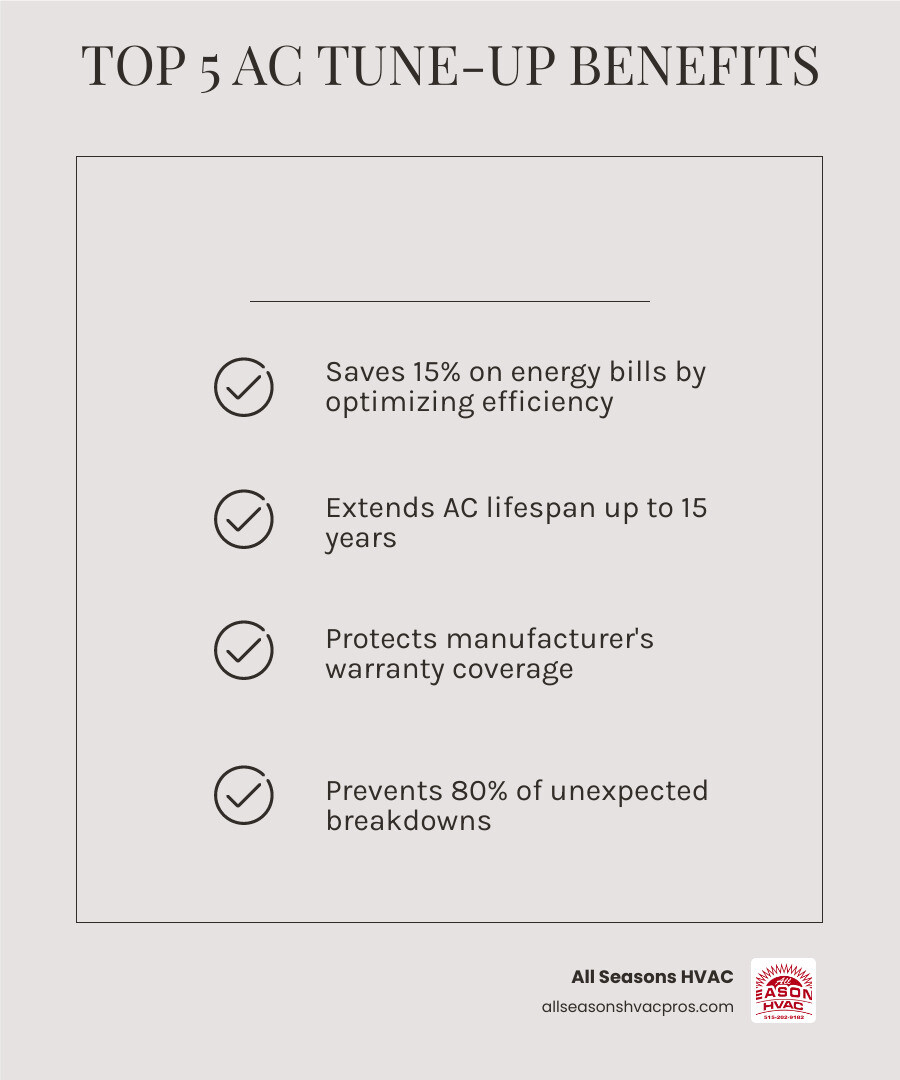
Skipping even one year of maintenance can quietly reduce your system’s efficiency, shorten its lifespan, and in many cases, void the manufacturer’s warranty. The good news is that staying on schedule is simple, affordable, and one of the smartest things you can do to protect your home comfort budget.
What is an AC Tune-Up and Why is it Essential?
Think of an AC tune-up like an oil change for your car. You wouldn’t drive your vehicle 20,000 miles without fresh oil and expect it to last, right? Your air conditioner is no different. A professional tune-up is a comprehensive inspection and cleaning designed to catch small issues before they become catastrophic (and expensive) failures.
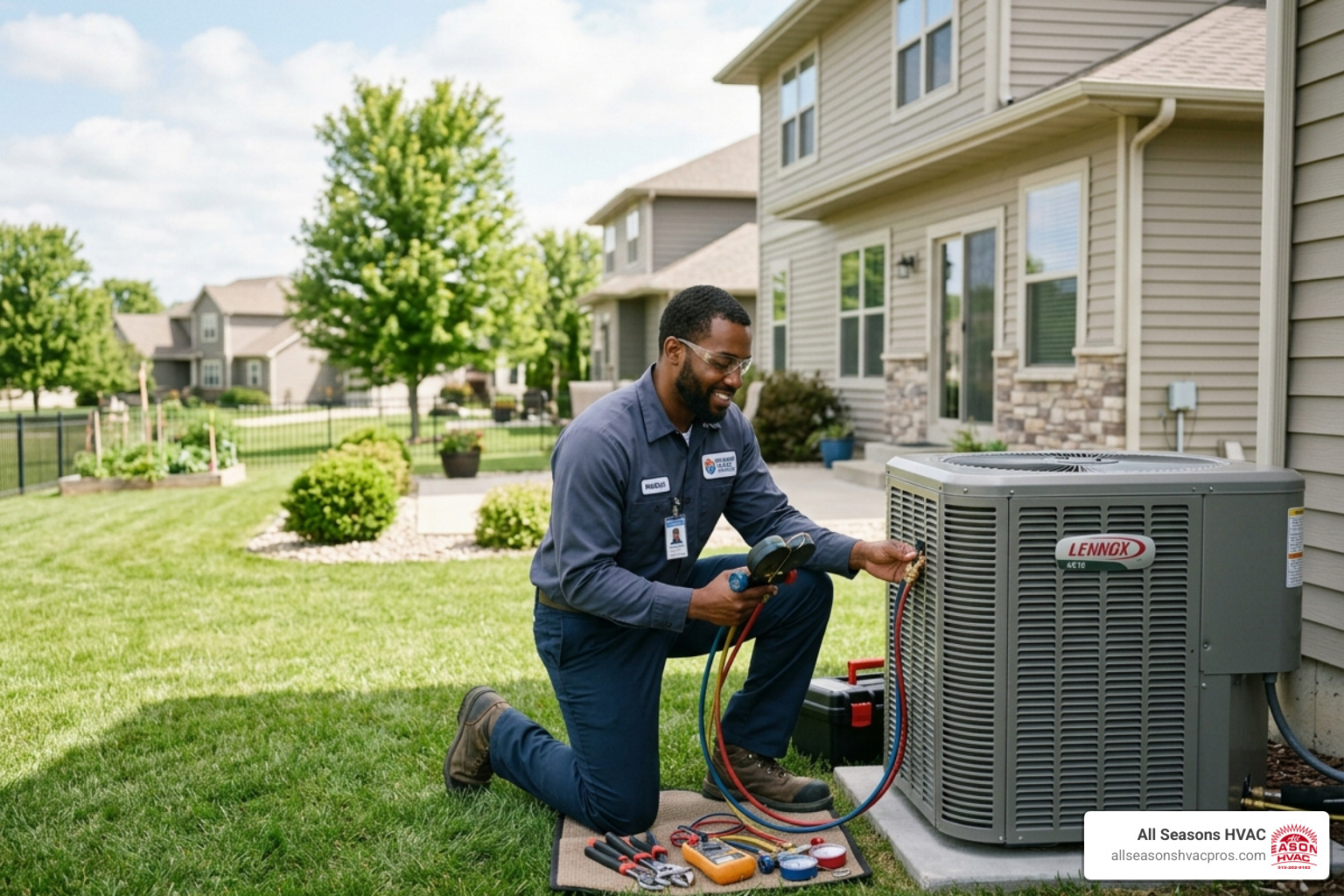
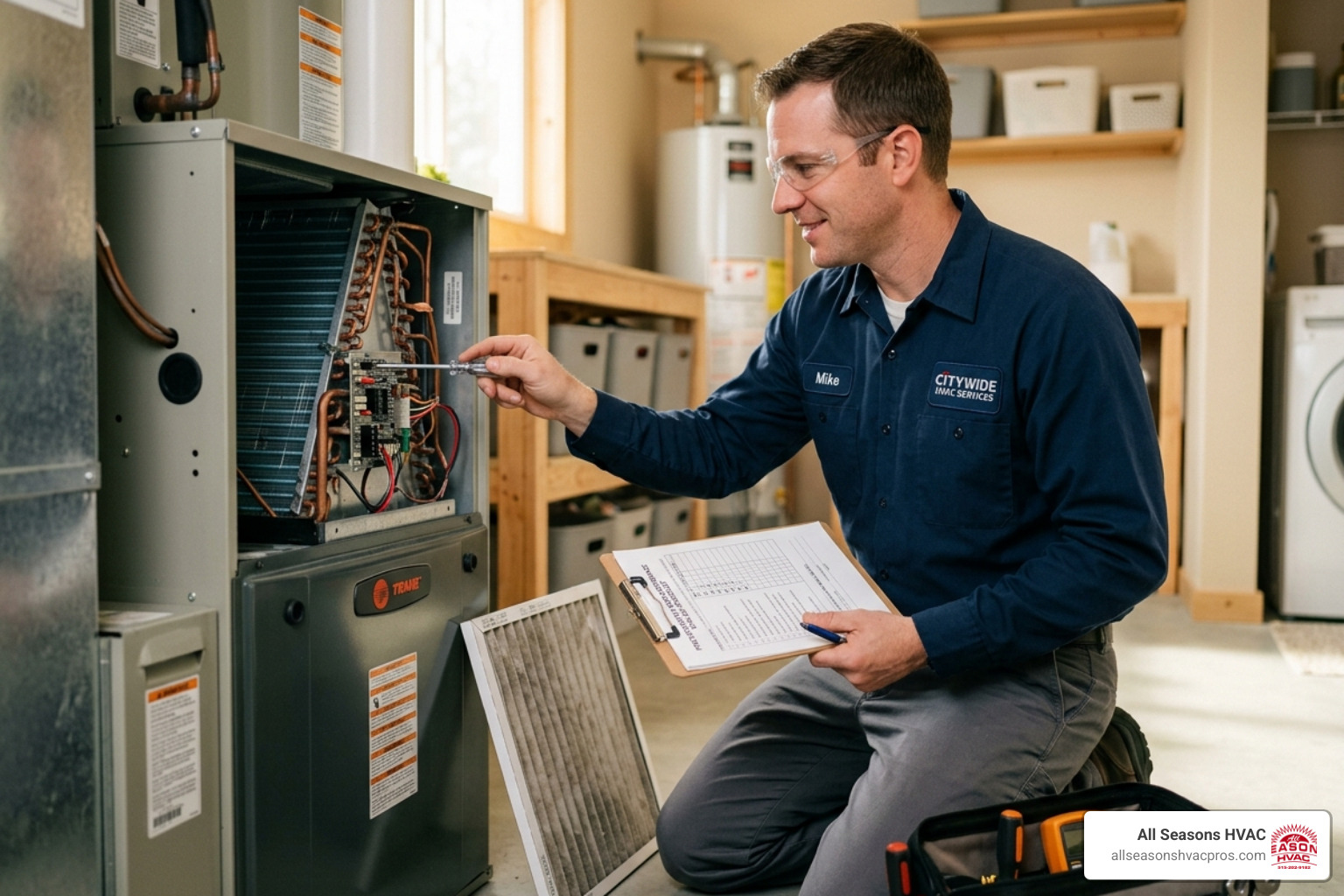
When we visit your home for AC maintenance, we don’t just “look” at the unit. We perform a series of technical tasks that ensure every component is pulling its weight. This includes:
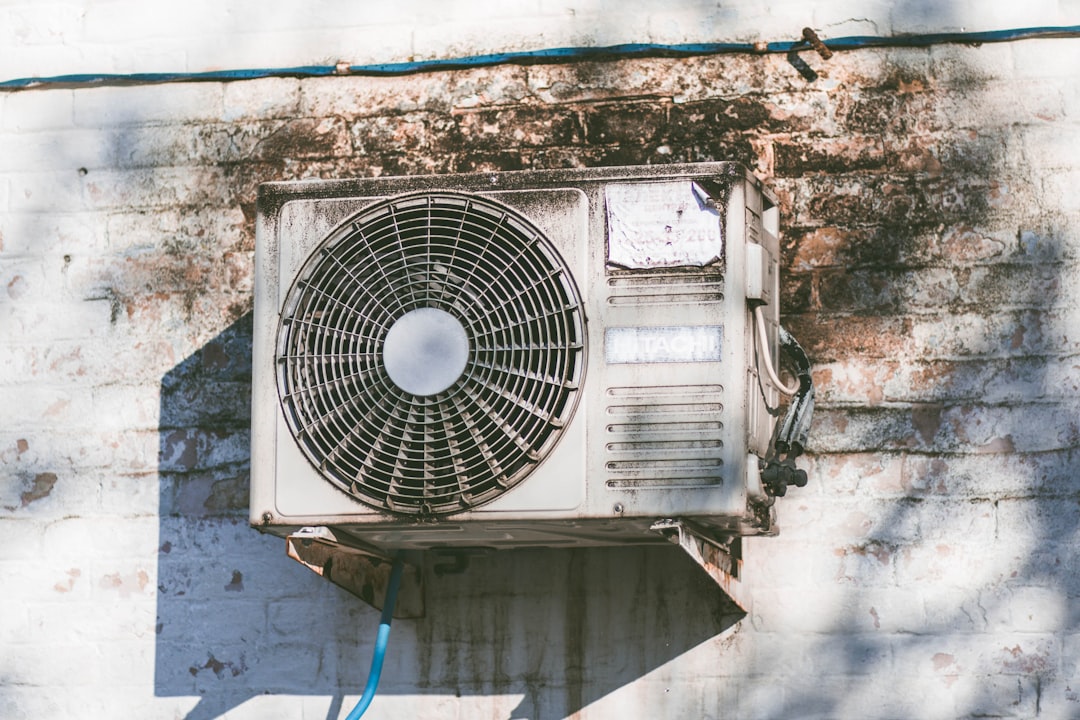
- Cleaning Vital Components: We remove dust and debris from the condenser and evaporator coils. Dirty coils can reduce efficiency by 15% to 25% because they force the system to work harder to transfer heat.
- Electrical Testing: We tighten all connections and measure the “draw” of your motors. We specifically check capacitors—those small cylindrical parts that help your motors start. If a capacitor is failing, your motor could burn out next.
- Refrigerant Assessment: We verify that your refrigerant levels are within the manufacturer’s specifications. Contrary to popular belief, refrigerant doesn’t “wear out.” If it’s low, there’s a leak that needs addressing.
- Thermostat Calibration: We make sure your thermostat is actually reading the temperature correctly so your system doesn’t cycle more often than necessary.
- Drain Line Clearing: We flush the condensate drain line to prevent algae buildup, which is a leading cause of water damage in Iowa basements.
By checking these items, we ensure your system isn’t just “running,” but running optimally.
How Often Should You Schedule an AC Tune-Up for Peak Performance?
In the industry, the “Golden Rule” is once per year. Even if your system seems to be cooling perfectly, internal wear and tear happens every single season. In Central Iowa, where we experience high humidity and sweltering July afternoons, your system is under significant stress.
For residents in West Des Moines, a yearly checkup is the baseline. This consistency prevents “scheduling gaps.” For example, if you schedule a tune-up in February one year and then wait until November the next year, your system has actually gone nearly 20 months without service. Sticking to a consistent annual timeframe is the best way to keep the internal components from degrading.
Why Older Systems Need More Frequent Attention
As your air conditioner blows past the 10-year mark, it begins to enter its “senior years.” Standard units typically last between 15 and 20 years if well-maintained, but as they age, parts become more brittle and efficiency naturally declines.
Older systems are more prone to electrical problems and mechanical wear. If your unit is over a decade old, we often recommend a mid-season checkup. This ensures that the strain of a 90-degree Iowa heatwave doesn’t push an aging component over the edge. If you find yourself calling for repairs more than twice a year, it might be time to look for signs you need AC replacement.
How often should you schedule an ac tune up in high-use environments?
Not every home uses its AC the same way. If you live in a rural area near Ankeny surrounded by fields, your outdoor unit is likely sucking in a lot more dust, pollen, and “cotton” from trees than a unit in a paved urban center.
Similarly, if you have multiple pets, your indoor return vents are pulling in fur and dander constantly. In these high-stress environments, how often should you schedule an AC tune-up? We suggest a “bi-annual” approach—once in the spring for the cooling side and once in the fall for the heating side. This ensures that the heavy buildup of dust and debris doesn’t choke your system’s airflow, which is the number one cause of premature compressor failure.
The Best Time of Year to Book Your Service in Central Iowa
Timing is everything. While we can perform a tune-up any time the temperature is above 60 degrees (needed for accurate refrigerant readings), the “sweet spot” is March and April.
Scheduling your Waukee AC maintenance in early spring offers several advantages:
- Technician Availability: Once the first 85-degree day hits in May, our phones ring off the hook with emergency “no-cool” calls. By booking in March or April, you get your choice of appointment times.
- Pre-Season Fixes: If we find a failing part during a spring tune-up, we can fix it before you actually need the air conditioning. This prevents that nightmare scenario of your AC breaking down on a Friday evening in July.
- Efficiency from Day One: Your system will be clean and calibrated before it starts its heavy lifting, saving you money on your very first summer utility bill.
Protecting Your Investment: Warranty Requirements and Longevity
Most homeowners are surprised to learn that their AC warranty isn’t just a “given.” Most major manufacturers (like Carrier, Lennox, or Trane) provide a 10-year parts warranty, but there is a catch: it usually requires proof of annual professional maintenance.
If your compressor fails in year seven and you cannot produce service records showing that a licensed pro maintained the unit every year, the manufacturer can legally deny your claim. This could turn a covered repair into a multi-thousand-dollar out-of-pocket expense.
Regular maintenance also prevents short cycling, where the system turns on and off too frequently. This constant “start-stop” puts immense strain on the compressor and motors. By keeping the system tuned, you ensure it reaches its full 15-to-20-year lifespan rather than burning out at year 10.
Recognizing the Signs You Need an AC Tune-Up Sooner Than Scheduled
Sometimes your air conditioner will tell you it’s struggling before its scheduled appointment. If you notice any of the following, don’t wait for your annual date—call us immediately.
- Rising Energy Bills: If your utility bill is 15% to 20% higher than it was the same month last year (and the weather hasn’t been significantly hotter), your system is losing efficiency.
- Inconsistent Cooling: If the living room is freezing but the bedrooms are sweltering, you likely have an airflow or refrigerant issue.
- Performance Red Flags: If your unit is running for hours without reaching the set temperature, it’s a sign that it’s not cooling properly.
- Ice on the Lines: If you see ice forming on the copper lines outside or the unit inside, you likely have refrigerant leak signs or a major airflow blockage.
Identifying Unusual System Noises
Your AC should hum and whistle a bit, but it shouldn’t scream, bang, or buzz.
- Banging: Usually indicates a loose part in the blower or compressor.
- Buzzing: Often points to electrical problems or a failing contactor.
- Hissing: This is a classic sign of a refrigerant leak.
If your AC is making strange noises, shut it down and call a pro. Continuing to run a noisy unit can turn a small repair into a total system replacement.
How often should you schedule an ac tune up when you notice weak airflow?
If you feel like you have to stand right in front of the vent to feel anything, you have an airflow problem. This is often caused by a clogged filter or a blower motor that is struggling due to lack of lubrication or a failing capacitor. Addressing poor AC airflow problems early can prevent your evaporator coil from freezing over, which can lead to water leaks and compressor damage.
Professional Service vs. Homeowner Maintenance Tasks
We love it when homeowners take an active role in their HVAC care! However, there is a big difference between basic upkeep and a professional tune-up.
| Task | Homeowner DIY | Professional Technician |
|---|---|---|
| Replace Air Filters (every 1-3 months) | Yes | Included |
| Clear Debris/Grass from Outdoor Unit | Yes | Included |
| Maintain 2-Foot Clearance Around Unit | Yes | Included |
| Flush Condensate Drain with Vinegar | Yes | Included |
| Test Electrical Capacitors & Contactors | No | Yes |
| Check Refrigerant Charge & Subcooling | No | Yes |
| Clean Internal Evaporator Coils | No | Yes |
| Lubricate Moving Parts/Bearings | No | Yes |
| Inspect Ductwork for Leaks | No | Yes |
While you can handle the filters and the weed-whacking around the unit in Urbandale, the technical work requires specialized tools like manifolds, multimeters, and EPA certification to handle refrigerant safely.
Frequently Asked Questions about AC Service Frequency
What factors affect the cost of a professional tune-up?
While we don’t list specific prices, several factors influence the investment. The type of system (central air vs. a ductless mini-split) and the size of the unit can play a role. Additionally, many homeowners in Indianola choose to join a maintenance plan. These plans often provide discounts on the tune-up itself, as well as priority scheduling and reduced fees for any repairs found during the visit.
How long does a typical AC tune-up take?
A thorough, professional tune-up usually takes between 60 and 90 minutes. If a company claims they can do it in 15 minutes, they aren’t actually doing the work—they are just doing a “drive-by” visual inspection. It takes time to properly clean coils, test electrical components, and verify refrigerant pressures. We take our time in Norwalk to ensure the job is done right the first time.
What happens if I skip my annual maintenance this year?
Skipping maintenance is a gamble. In the short term, your energy bills will likely creep up by 5% to 10% as the system struggles with dirty coils. In the long term, you risk a total system breakdown during the hottest week of the year. Furthermore, neglect is the primary cause of AC water leaks, as dust and sludge clog the drain pan, leading to overflows that can ruin your ceiling or flooring.
Conclusion: Keep Your Central Iowa Home Cool All Summer Long
At All Seasons HVAC LLC, we believe that home comfort shouldn’t be a source of stress. By answering the question of how often should you schedule an AC tune-up with a consistent annual plan, you are investing in your home’s efficiency and your family’s comfort.
Whether you are in Des Moines, Ankeny, or Waukee, our team of experienced technicians is ready to help you extend the life of your system. We also offer budget-friendly financing plans to make sure that essential upgrades and maintenance are affordable for every Central Iowa family.
Don’t wait for the heat to arrive. Schedule your professional AC maintenance in Des Moines today and enjoy the peace of mind that comes with a well-tuned system.